
Quick Conversion Table
| Brand | Equivalent | Match |
|---|---|---|
| Anchor | 8581 | exact |
| Madeira | 1812 | close |
| Cosmo ⚠ | 894 | close |
| Sullivans | 45152 | close |
| J&P Coats | 8500 | close |
| Dimensions | 18900 | close |
| Bucilla | 3646 | close |
Problem-solving is where DMC 646 Dark Beaver Gray really earns its reputation. The specific problem it solves: you need a medium-dark gray for fill work, but every available option is either too cool (reading purple or blue on warm fabric) or too warm (reading brown rather than gray). DMC 646 threads the needle — pun intended — by sitting in that elusive temperature-neutral zone where the gray reads as genuinely gray in most lighting conditions. Experienced stitchers reach for it specifically when other grays have failed them.
Temperature Neutrality as an Asset
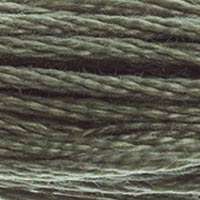
The hex value #877D73 breaks down to red=136, green=130, blue=128 — almost perfectly balanced between the channels, with just the faintest warm lean. In practice, this means 646 behaves consistently across different fabric colors and lighting conditions, which many grays don't. Work it on white Aida and it reads as medium-dark warm gray. Work it on antique linen and it harmonizes naturally rather than fighting the ground. Under tungsten light it picks up slight warmth; under fluorescent or daylight it reads more neutral. This adaptability is genuinely unusual.
Compare it to DMC 413 Dark Pewter Gray, which has a strong blue-gray quality that pops on warm fabrics, or DMC 535 Very Light Ash Gray at the lighter end. Neither is wrong, but they're not interchangeable with 646. The beaver grays (645–648) occupy a temperature position the pewter and ash grays don't, which is why a complete stash needs representatives from each family rather than just one gray sequence.
How It Works in a Full Palette
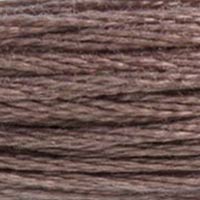
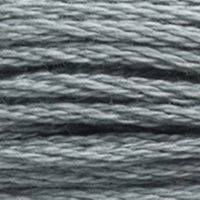
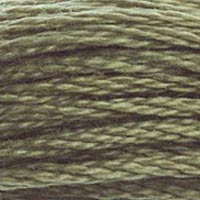
In the Beaver Gray family shading sequence, 646 handles the upper shadow range — deeper than the mid-tones worked in DMC 647, lighter than the deep shadows of DMC 645. In a four-tone sequence running from 645 through 646, 647, and 648, 646 carries the transition zone where shadow begins to open into mid-light. This is often the largest area in a shaded form, which means 646 frequently consumes more thread than its neighbors in the sequence. Planning stash quantities accordingly saves mid-project frustration.
For backstitching and outline work, 646 paired with fill areas worked in 647 and 648 creates definition that reads as natural edge rather than hard line — useful in naturalistic and botanical styles. Blackwork stitchers sometimes use 646 as a secondary line weight alongside DMC 310 black, allowing areas closer to the viewer to pop with true black while receding areas use 646's softer dark.
Gray Fur and Feather Texture
Threadpainting projects use 646 extensively for gray animal fur in the middle-shadow zones. Along with DMC 645 and 647, it builds the vocabulary of gray fur texture — the parallel stitch lines in needle painting shade from 645 at the base to 648 at the tips, with 646 carrying the crucial transition. For gray-feathered birds — herons, pigeons, mockingbirds — the same sequence applies, though feather shading has a more directional character than fur that benefits from careful railroading to keep each strand flat and parallel.
For stitchers building the complete Beaver Gray family into their stash, 646 is the value that tends to run out first in complex wildlife or portrait pieces. It covers the broad mid-shadow area where the most territory exists, consuming thread faster than the darker 645 (which appears only in the deepest recesses) or the lighter 647 and 648. Planning to purchase two skeins of 646 where you'd buy one of the others is sound practice when starting a large full-coverage project using this family.
Anchor 8581 and Madeira 1812 are exact matches. Note that Anchor 8581 uses the older five-digit numbering system seen on vintage Anchor cards — some online suppliers list it as simply 8581 while others use alternative catalog formats. Verify you're ordering the correct thread if purchasing Anchor by number from an unfamiliar supplier.
Cosmo 894 and Sullivans 45152 are close. Cosmo 894 tends toward slightly cooler — there's more gray and less beige in its undertone than in DMC 646. For most fill work this difference is irrelevant. Where it matters is when 646 is doing temperature-blending work between warm and cool palette sections; the cooler Cosmo 894 will shift that blend slightly. Sullivans 45152 is very close in most lighting conditions, though some stitchers report slight sheen differences — Sullivans can have marginally less lustre at this value.
Within DMC, if 646 is unavailable, there's no single perfect substitute. DMC 3021 Very Dark Brown Gray is darker and slightly warmer. DMC 535 Very Light Ash Gray is both lighter and cooler, useful only if your project can accommodate a shift in both directions. For a blended-needle improvisation, one strand of 645 and one strand of 647 creates a reasonably convincing 646 equivalent in two-strand work — the eye blends them at normal viewing distance into something close to the target value and temperature.
Reference quality
How We Validate This Color Record
Use this page as a reference card for DMC 646: the structured data, quick conversions, and long-form copy are all tied back to the same stored color record.
- Methodology
- This page renders DMC 646, its hex value, and every brand equivalent from the site's source-of-truth color record, then checks long-form body copy against those same stored fields.
- Verification status
- Source-field checked. The page content is audited against the stored DMC number, brand equivalents, and match-quality labels before publishing.
- Last reviewed
- 2026-04-20
- Approximation warning
- Screen hex values, thread photos, and cross-brand conversions are reference aids. Dye lots, thread sheen, and fabric color can still shift the result in hand.
Decision guide
When to use the DMC 646 reference page
This page should help you decide faster between palette planning, brand substitution, and shade comparison without turning the color record into a thin lookup page.
Best for
- + Palette planning when you want the stored DMC 646 Dark Beaver Gray record, hex value #877D73, and linked brand equivalents in one place.
- + Checking the quickest cross-brand shortlist before you buy floss, compare stash substitutes, or route into a more specific conversion page.
- + Finding nearby shades in the neutrals family before you commit to accents, shading, or background blends.
Watch for
- ! Screen previews are only reference aids. Dark Beaver Gray can shift on real fabric because thread sheen, stitch coverage, and room lighting change how the color reads.
- ! A stored equivalent is still a shortlist, not a guarantee that two brands will disappear into each other in the same stitched motif.
- ! Older charts, discontinued kit floss, and dye-lot variation can all introduce small but visible differences that the page cannot detect for you.
Before you commit
- Confirm the role of DMC 646 Dark Beaver Gray: decide whether you need an exact hero shade, a forgiving background, or a rough stash substitute.
- Compare on project fabric: view the skein or stitched sample on the same fabric count and color you will actually use.
- Use the linked conversion pages next: open the brand-specific pages when you need match-quality caveats before substituting away from the DMC reference.
DMC 646 FAQ
These questions appear on the page so the FAQ schema stays aligned with what visitors can actually read.
What is the Anchor equivalent of DMC 646?+
The closest Anchor equivalent to DMC 646 (Dark Beaver Gray) is Anchor 8581. This is an exact match.
What color is DMC 646?+
DMC 646 is called "Dark Beaver Gray" and has a hex color value of #877D73. It belongs to the neutrals color family.
What is the Madeira equivalent of DMC 646?+
The closest Madeira equivalent to DMC 646 (Dark Beaver Gray) is Madeira 1812. This is a close match.
How DMC 646 Looks on Fabric
The same thread appears different depending on your fabric. Always test on your project fabric.
White Aida
Cream / Ecru
Black Aida
Pairs Well With
DMC colors commonly used alongside 646 Dark Beaver Gray.
Suggested Palette
Shading Companions
Detailed Conversions
Where to Buy DMC 646
This section contains affiliate links. We may earn a small commission at no cost to you.
Related Guides
Free Printable Thread Conversion Chart
Pick a brand, enter your email, and we'll send you a printable chart mapping all 552 DMC colors to that brand's equivalents. Zero spam, one chart.
Thanks! Here's your free chart:
Download Your ChartOpens in a new tab. Use your browser's Print → Save as PDF.
No spam. Your email is stored securely and never shared.