
Quick Conversion Table
| Brand | Equivalent | Match |
|---|---|---|
| Anchor | 188 | close |
| Madeira | 1203 | close |
| Cosmo ⚠ | 845 | close |
| Sullivans | 45448 | close |
| J&P Coats | 6187 | close |
When Green and Cyan Are the Same Color
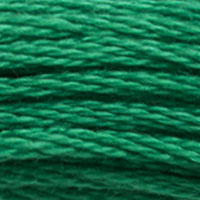
Mathematically, DMC 3850 Dark Bright Green is interesting: its hex value #378477 means equal parts green and blue, no red. This puts it at the exact midpoint between pure green and pure cyan on the visible spectrum — the point where the color's family membership becomes genuinely ambiguous. Classified as a green in the DMC system, it reads convincingly as dark teal-green in most contexts, but also convincingly as a deep sea-green or even a saturated forest-water color depending on what surrounds it.
The practical result of this mathematical symmetry is a color of unusual versatility. It pairs with both green palettes and blue-green palettes without tension. It works as the dark anchor in a teal scheme or as the cool, shadowed green in a forest scene. Designers use it for malachite stone effects, for the deep, opaque green of antique glass, and for the color of deep forest pools where the water is stained with minerals.
DMC 3850 and DMC 3851 (Light Bright Green) form a two-color family within the bright green designation. The jump between them is substantial — about two full value steps — which means the pair works well as a two-shade shorthand in small design elements without needing a mid-tone. For larger, more nuanced shading, adding DMC 3849 (Light Teal Green) on the light side and DMC 500 (Very Dark Blue Green) on the dark side gives a more complete gradient range.
Historical and Material Connections
This precise green-cyan — saturated, slightly cool, neither warm spring green nor cool aqua — is the color of malachite, the copper mineral used as a pigment and decorative stone since ancient Egypt. Malachite green was one of the earliest stable green pigments in painting and dyeing, and its distinctive banded-and-solid quality has been a decorative motif since antiquity. For stitchers creating designs inspired by stone, mineral, or geological themes, 3850 is the obvious malachite reference.
In contemporary cross-stitch, this color shows up in modernist geometric designs where a high-saturation dark teal-green provides visual weight and depth in contrast to lighter, more neutral elements. It's a popular choice for the darkest color in a teal-and-turquoise gradient panel, where its depth allows other family members to appear comparatively bright and luminous.
Coverage is full and consistent on standard count fabrics. The high saturation makes tension irregularities somewhat visible, so railroading is recommended for large fills. On black or very dark fabric, 3850 reads clearly enough to be useful — it doesn't disappear the way lighter colors do on dark grounds, making it viable for partial-coverage designs on dark Aida.
All substitutions for DMC 3850 Dark Bright Green are rated close, reflecting the difficulty of matching this precisely balanced cyan-green across brands.
Anchor 188 is close. In this color zone, Anchor's options may lean slightly more toward blue-teal than 3850's more balanced green-cyan position. The difference is minor in most finished contexts but visible in direct thread comparison.
Madeira 1203 is close. Madeira's bright green family at this value range tends to be a reliable match — 1203 is a dependable substitute for large-scale projects in teal-green palettes. The saturation level is comparable to the DMC version.
Cosmo 845 is close. Cosmo's equivalent in the bright green-teal range tends toward slightly more vivid saturation, which can read as a cleaner, more electric version of 3850's controlled quality. For designs that benefit from maximum vibrancy, this can be a useful trade-off.
Sullivans 45448 is close and functional for standalone projects. As with other saturated Sullivans colors, confirming lot consistency is advisable.
- For a warmer alternative that shifts toward forest green rather than cyan, DMC 991 (Dark Aquamarine) leans slightly more green while maintaining similar value and saturation.
- To push further into the blue family at similar depth, DMC 3842 (Dark Wedgwood) shifts toward a deeper teal-blue while losing the green component.
Reference quality
How We Validate This Color Record
Use this page as a reference card for DMC 3850: the structured data, quick conversions, and long-form copy are all tied back to the same stored color record.
- Methodology
- This page renders DMC 3850, its hex value, and every brand equivalent from the site's source-of-truth color record, then checks long-form body copy against those same stored fields.
- Verification status
- Source-field checked. The page content is audited against the stored DMC number, brand equivalents, and match-quality labels before publishing.
- Last reviewed
- 2026-04-20
- Approximation warning
- Screen hex values, thread photos, and cross-brand conversions are reference aids. Dye lots, thread sheen, and fabric color can still shift the result in hand.
Decision guide
When to use the DMC 3850 reference page
This page should help you decide faster between palette planning, brand substitution, and shade comparison without turning the color record into a thin lookup page.
Best for
- + Palette planning when you want the stored DMC 3850 Dark Bright Green record, hex value #378477, and linked brand equivalents in one place.
- + Checking the quickest cross-brand shortlist before you buy floss, compare stash substitutes, or route into a more specific conversion page.
- + Finding nearby shades in the greens family before you commit to accents, shading, or background blends.
Watch for
- ! Screen previews are only reference aids. Dark Bright Green can shift on real fabric because thread sheen, stitch coverage, and room lighting change how the color reads.
- ! A stored equivalent is still a shortlist, not a guarantee that two brands will disappear into each other in the same stitched motif.
- ! Older charts, discontinued kit floss, and dye-lot variation can all introduce small but visible differences that the page cannot detect for you.
Before you commit
- Confirm the role of DMC 3850 Dark Bright Green: decide whether you need an exact hero shade, a forgiving background, or a rough stash substitute.
- Compare on project fabric: view the skein or stitched sample on the same fabric count and color you will actually use.
- Use the linked conversion pages next: open the brand-specific pages when you need match-quality caveats before substituting away from the DMC reference.
DMC 3850 FAQ
These questions appear on the page so the FAQ schema stays aligned with what visitors can actually read.
What is the Anchor equivalent of DMC 3850?+
The closest Anchor equivalent to DMC 3850 (Dark Bright Green) is Anchor 188. This is a close match.
What color is DMC 3850?+
DMC 3850 is called "Dark Bright Green" and has a hex color value of #378477. It belongs to the greens color family.
What is the Madeira equivalent of DMC 3850?+
The closest Madeira equivalent to DMC 3850 (Dark Bright Green) is Madeira 1203. This is a close match.
How DMC 3850 Looks on Fabric
The same thread appears different depending on your fabric. Always test on your project fabric.
White Aida
Cream / Ecru
Black Aida
Pairs Well With
DMC colors commonly used alongside 3850 Dark Bright Green.
Suggested Palette
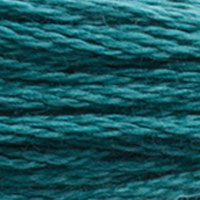
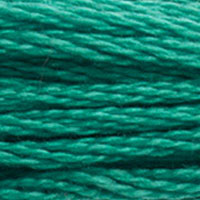
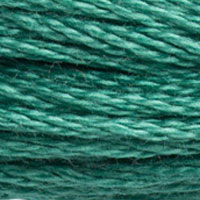
Shading Companions
Detailed Conversions
Where to Buy DMC 3850
This section contains affiliate links. We may earn a small commission at no cost to you.
Related Guides
Free Printable Thread Conversion Chart
Pick a brand, enter your email, and we'll send you a printable chart mapping all 552 DMC colors to that brand's equivalents. Zero spam, one chart.
Thanks! Here's your free chart:
Download Your ChartOpens in a new tab. Use your browser's Print → Save as PDF.
No spam. Your email is stored securely and never shared.