
Quick Conversion Table
| Brand | Equivalent | Match |
|---|---|---|
| Anchor | 1040 | exact |
| Madeira | 1813 | close |
| Cosmo ⚠ | 893 | close |
| Sullivans | 45153 | close |
| J&P Coats | 8900 | close |
| Dimensions | 18900 | close |
| Bucilla | 647 | close |
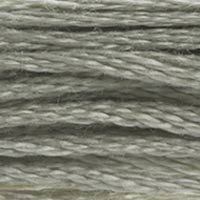
Gradient work in embroidery lives and dies by the quality of its mid-tones, and DMC 647 Medium Beaver Gray is one of the best mid-tones in the gray family. Not because it's remarkable on its own — it's a quiet, unassuming medium gray with the characteristic warmth of the beaver gray sequence — but because it performs the hardest job in any gradient: the transition. Where 645 and 646 establish depth and 648 handles the light end, 647 carries the eye from shadow to highlight in a way that reads as continuous, natural progression rather than stepped bands of color.
The Transition Specialist
In threadpainting and needle painting techniques, mid-tones like 647 do the most work by area, even though they're rarely the most visually striking color on the palette. A convincing gradient from DMC 645 Very Dark Beaver Gray up to DMC 648 Light Beaver Gray requires that 647 is the thread that appears most frequently and covers the most territory. Too little of it and the gradient looks like two separate tones with a thin bridge. Too much and the shadow range lacks depth and the light range lacks lift.
The same principle applies in conventional counted cross stitch shading, though the individual stitch character means the blending is more graphic. Stitchers who work the English method and complete one cross at a time will often mix 647 with adjacent values using a blended needle — one strand of 646 and one of 647, or one of 647 and one of 648 — to create intermediate tones that smooth the transition further. This technique, used judiciously in the gradient zones, gives cross stitch a depth that rivals thread painting without the complexity.
Gray-Scale Design Work
Monochrome and gray-scale embroidery has experienced a genuine renaissance in the cross stitch community, partly driven by the popularity of dramatic portrait designs and partly by minimalist aesthetic trends. DMC 647 is essential to any stitcher exploring this style. In a five-tone gray-scale sequence — say, DMC 310, 645, 647, 648, and 3865 — 647 is the third tone, and in portrait work it often covers cheeks, mid-light areas of hair, and the lighter shadow zones that give a face its roundness.
When working blackwork patterns that use gray fill areas alongside the traditional black outline work, 647 provides a medium-value fill that suggests form without competing with the primary design lines. It reads as background depth rather than as a separate color element, which is exactly what blackwork fill requires.
Pairs and Palette Suggestions
Against warm colors — dusty rose, aged gold, soft terracotta — DMC 647's slight warmth keeps it from creating jarring temperature contrast. It sits comfortably alongside DMC 3722 Medium Shell Pink or DMC 3861 Light Cocoa in feminine palette designs without the clash that cooler grays would create. For bird embroidery, pairing 647 with DMC 453 Light Shell Gray and DMC 644 Medium Beige Gray creates the soft, naturalistic palette of doves, wrens, and sparrows — birds whose coloring looks simple but requires careful temperature management to render convincingly.
Anchor 1040 and Madeira 1813 are both exact matches, making DMC 647 a well-supported color across the major brands. Anchor 1040 is part of Anchor's newer numbering system and has good availability in most markets.
Cosmo 893 and Sullivans 45153 are rated close. Cosmo 893 runs slightly cooler than DMC 647 — the gray reads a touch more blue-neutral. In blended shading work where 647 is used for transitions, this subtle temperature shift is worth knowing about. Sullivans 45153 is very similar in practice; some stitchers report it as slightly less consistent in dye lot across purchases, which matters for large WIPs.
Within the DMC range, 647 is sandwiched between 646 and 648 in the same family — substituting either neighbor is the obvious move depending on whether you need to shift slightly darker or lighter. In a pinch, for a genuinely neutral mid-gray that isn't from the beaver family, DMC 317 Pewter Gray is close in value but noticeably cooler; it'll work in non-temperature-sensitive applications but will read differently in warm palettes. One strand of 645 plus one strand of 648 in a blended needle creates a convincing 647 approximation at two-strand coverage.
For stitchers who work large monochrome portrait pieces, 647 is worth buying in quantity before starting. It's the gray that covers the most ground — mid-tones in a complex shading sequence always cover more area than either the darks or the lights, and in a portrait with realistic face shading, 647 will appear across foreheads, cheeks, necks, and hands wherever the skin is in moderate light. Two or three skeins is not excessive for a full-figure portrait or large animal piece. Checking available stock and dye lots before starting saves the mid-project scramble.
Reference quality
How We Validate This Color Record
Use this page as a reference card for DMC 647: the structured data, quick conversions, and long-form copy are all tied back to the same stored color record.
- Methodology
- This page renders DMC 647, its hex value, and every brand equivalent from the site's source-of-truth color record, then checks long-form body copy against those same stored fields.
- Verification status
- Source-field checked. The page content is audited against the stored DMC number, brand equivalents, and match-quality labels before publishing.
- Last reviewed
- 2026-04-20
- Approximation warning
- Screen hex values, thread photos, and cross-brand conversions are reference aids. Dye lots, thread sheen, and fabric color can still shift the result in hand.
Decision guide
When to use the DMC 647 reference page
This page should help you decide faster between palette planning, brand substitution, and shade comparison without turning the color record into a thin lookup page.
Best for
- + Palette planning when you want the stored DMC 647 Medium Beaver Gray record, hex value #B0A69C, and linked brand equivalents in one place.
- + Checking the quickest cross-brand shortlist before you buy floss, compare stash substitutes, or route into a more specific conversion page.
- + Finding nearby shades in the neutrals family before you commit to accents, shading, or background blends.
Watch for
- ! Screen previews are only reference aids. Medium Beaver Gray can shift on real fabric because thread sheen, stitch coverage, and room lighting change how the color reads.
- ! A stored equivalent is still a shortlist, not a guarantee that two brands will disappear into each other in the same stitched motif.
- ! Older charts, discontinued kit floss, and dye-lot variation can all introduce small but visible differences that the page cannot detect for you.
Before you commit
- Confirm the role of DMC 647 Medium Beaver Gray: decide whether you need an exact hero shade, a forgiving background, or a rough stash substitute.
- Compare on project fabric: view the skein or stitched sample on the same fabric count and color you will actually use.
- Use the linked conversion pages next: open the brand-specific pages when you need match-quality caveats before substituting away from the DMC reference.
DMC 647 FAQ
These questions appear on the page so the FAQ schema stays aligned with what visitors can actually read.
What is the Anchor equivalent of DMC 647?+
The closest Anchor equivalent to DMC 647 (Medium Beaver Gray) is Anchor 1040. This is an exact match.
What color is DMC 647?+
DMC 647 is called "Medium Beaver Gray" and has a hex color value of #B0A69C. It belongs to the neutrals color family.
What is the Madeira equivalent of DMC 647?+
The closest Madeira equivalent to DMC 647 (Medium Beaver Gray) is Madeira 1813. This is a close match.
How DMC 647 Looks on Fabric
The same thread appears different depending on your fabric. Always test on your project fabric.
White Aida
Cream / Ecru
Black Aida
Pairs Well With
DMC colors commonly used alongside 647 Medium Beaver Gray.
Suggested Palette
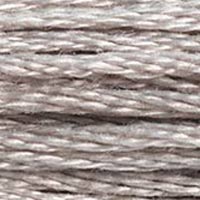
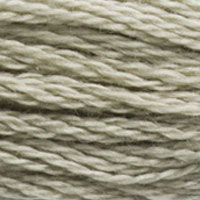
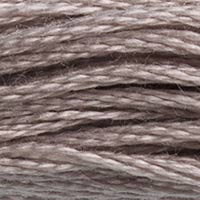
Shading Companions
Detailed Conversions
Where to Buy DMC 647
This section contains affiliate links. We may earn a small commission at no cost to you.
Related Guides
Free Printable Thread Conversion Chart
Pick a brand, enter your email, and we'll send you a printable chart mapping all 552 DMC colors to that brand's equivalents. Zero spam, one chart.
Thanks! Here's your free chart:
Download Your ChartOpens in a new tab. Use your browser's Print → Save as PDF.
No spam. Your email is stored securely and never shared.